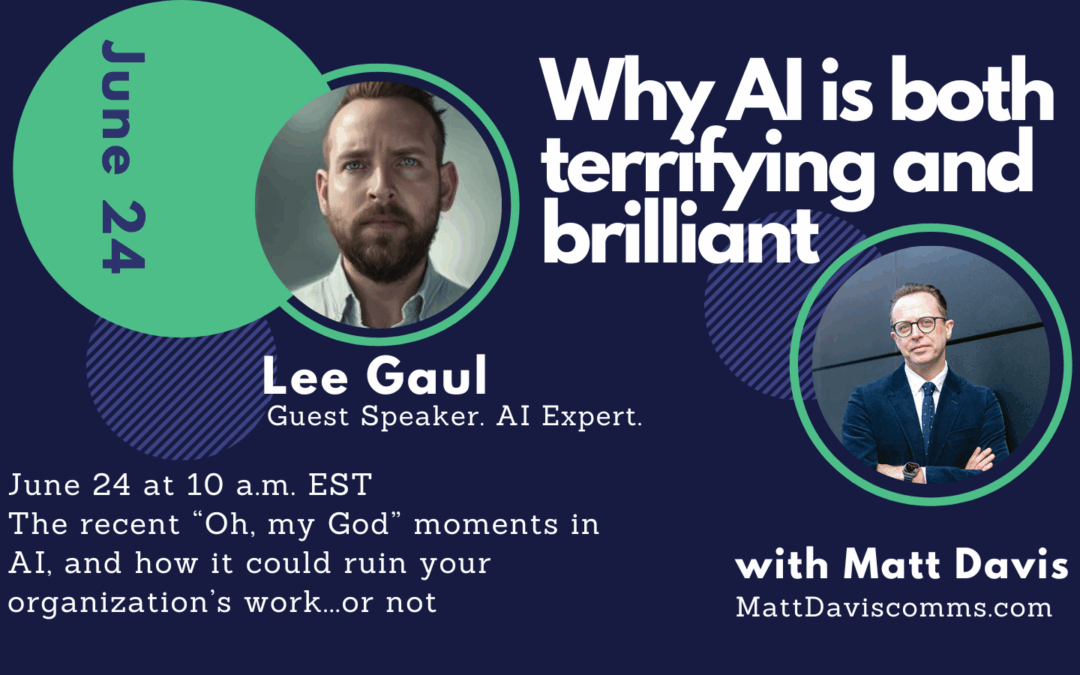
My good friend and colleague Lee Gaul and I are going to be discussing AI next week if you’d like to join us.
Lee is an AI expert and the kind of guy who “early adopts” things. His apartment is full of smart lightbulbs so he can program them to all turn red when you watch Stranger Things. You know?
We were talking a couple of weeks ago about Google’s new AI suite, and decided to give it a test. He’d tried getting it to write a short story and it was, I’m not kidding, quite good. I sat down at AI.Dev and gave it a series of prompts.
“Write the first chapter of a John Le Carre-type spy novel,” I told it.
“Make it about a lonely man in an exotic location. He is both loyal to his country and also questioning concepts of loyalty and country. I want the writing to be full of a sense of that division in his personality. I want there to be a longing about it. He’s desperate. Focus on building the atmosphere. I want you to throw me right in and leave me hungry for more.”
It thought for about 30 seconds and produced a 1,500 word chapter. I read it aloud to Lee and about 600 words in, we both turned to each other and said, “oh, sh*t.”
Like, it was very very good. It was outlandish. I had a shiver down my neck. Bladerunner has a famous test to find out if somebody is a robot. But Lee and I had come up with a better test. Could AI produce something we both enjoyed? We went out for a bagel and had a lot of very good ideas about how to make billions of dollars based on our discovery. It was very exciting.
I pride myself on being able to tell real spy fiction from the kind of stuff that’s copying it. I hate Slow Horses, for example, because it’s clear the writer wishes he was John Le Carre. That’s it. But this chapter was excellent. There were touches of real brilliance. I found myself thinking, “hold on, I could spend a few weeks prompting this thing and write a whole novel. It wouldn’t take a lot of editing to make it publishable.”
So long, writer’s block!
I went home and played around with the tool. I wrote, like, three or four outlines of entire novels with it. I wrote chapters of mysteries. Chapters of the same spy book. I got the AI to analyze my plot structure and make suggestions for where it was lacking. Where it needed more juice. I’ve spent a lot of time fooling around with the technology since. I have no doubt we’re already reading tons of AI-produced content without realizing it. With good editing, there’s no reason this raw material shouldn’t end up published.
But there are risks, of course. Our webinar next week is about the “oh, God” moments with AI, and what they mean for you, your future, and your work. If you run an organization then our talk is also for you. How can that sense of, “oh, wow” permeate your culture without risking the farm? How do you go from excitement to management to delivering results?
I do have a deep skepticism of AI, but I’m also fascinated to talk with Lee about the possibilities it presents. He’s got countless examples of recent “oh, no” moments, as well as great ideas for embedding AI tech. I hope you’ll join us and I can’t wait to explore the issue. Bring your questions and “what-ifs.” Treat Lee like an AI doctor. He’s here to diagnose and fix your challenges, too.
____
Matt Davis is a strategic communications consultant in Manhattan.