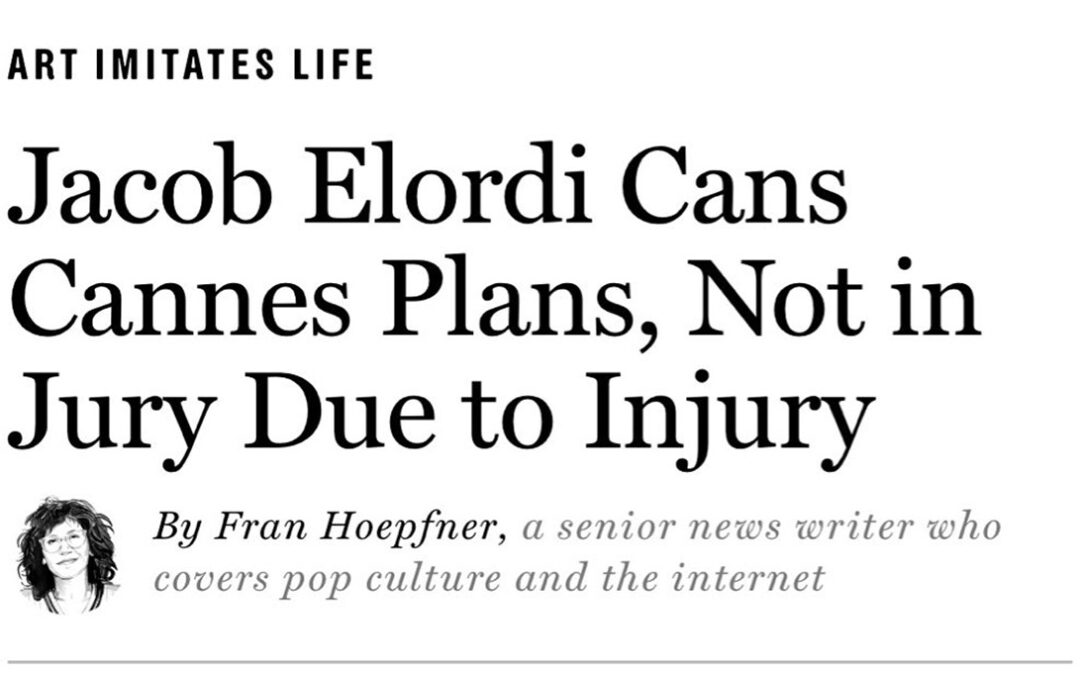
For those following media, puns are the new black. Fran Hoepfner with Vulture, for example, captured Twitter’s heart on May 6 with this beautiful headline pun 👆🏻 about the Frankenstein star, Jacob Elordi’s, withdrawal from Cannes. It’s very good indeed and far from the only recent example of an eye-catching pun in the press.
The pun-ai-ssance is driven, of course, by the media’s desire to assert our human creativity and sense of wit as AI rears into view. Two weeks after Fran wrote that headline, James Murdoch also announced a plan to buy her publication and says he wants its “thoughtful journalism.” Fingers crossed for the likes of Ms. Hoepfner, eh?
AI can curate a number of sources into a coherent article, sure. And that’s what we used to do, day in, and day out, as journalists collecting salaries. Admittedly some of us used to actually get people to say things, and cultivate such sources rather than simply quote other online references without engaging with them, but I’m splitting hairs about the value of actual reporting, which is a dying art. Can AI bring its sense of humor into play and create a headline that witty for a story reported by a human, or a computer? No, it can’t. I promise you. Not even when you set it to “Deep Think” mode.
The robots might all be coming for our jobs eventually, and I’m sure it’s only a matter of time before Anthropic creates ReporterBot1000™ and PunBot5000™, but for the time being instead of having a serious conversation about what all this might mean, yawn, yawn, us media types are fiddling with our headlines while Rome burns.
Tabloid papers like the New York Post have long embraced puns on their front and back pages as a way of separating themselves from the competition on the news stand. Consider “Kam on In” to describe Kamala Harris’s attitude to controlling immigration, or “Hochul-ding Out For More” about the state’s Governor, Kathy Hochul, and tensions over her gridlocked state budget. They even described the market impact of Donald Trump’s trade policy as “Tariff-Ying,” so they did.
I started noticing an increase in puns in the snooty magazine, World of Interiors, during Covid. Those of us who subscribe are a niche crowd, but we do appreciate a little linguistic nuance, a little chuckle as we’re paging through its escapist photographic spreads. Consider “Tuft Love” as the headline for a brief item introducing a £17,850 sofa. I can’t afford the sofa, but laughing about it is comparatively cheap. Or “Cabinet Reshuffle” as the headline for a piece about a dutchman whose repurposed cupboards are the centrepiece of his home renovation in the Hague. Or “Candle Schtick” for a piece about a menorah shop in Morocco. Strong work!
Even serious outlets aren’t immune. The Financial Times ran a column in 2010 entitled “Gilt Trip” about gold prices, and recently a piece called “Crude Awakening” about the Iran War’s impact on oil markets. An FT journalist also coined the term “TACO Trade” to describe Donald Trump’s attitude to market-moving decisions like his tariffs. The Wall Street Journal, too, has mulled over swimming pools “sinking home values,” and ran a travel safari piece entitled “Where the Wild Things Aren’t” in 2020. Bravo! I
’ve been embracing puns, too. I edit a newsletter for Cheddar.com called Need2Know (join our half-a-million subscribers here!) and for the thousands of people who want one (they’re strictly “opt-in options,” thanks to dynamic content options) it always opens with a cheese pun, thanks to my former editor, Matt Gross, and his grokking the fact people might be able to get their tech, business and finance news from a variety of outlets. But where are they going to go for the world’s best cheese puns, eh? That’s right. They’re coming straight to me. Consider these beauties from the last three days:
- The only way I’ll compromise the integrity of this cheese pun is if you give me a suitcase full of Kash-kaval. And as we all know, Kashkaval is a semi-hard yellow cheese originating from the Balkans, often dubbed the “cheddar of the Balkans.”
- It would be a major-errrro-r to underestimate the power of this cheese pun. Because Majorero, as we all know, is also known as Queso Fuerteventura, since it is made from the unpasteurized milk of Majorera goats on the island of Fuerteventura in the Canary Islands.
- The Rachel Papers. It’s Martin Amis’s collectable debut novel from 1974, a bittersweet riff on first love and adolescent ennui. And as we all know, Rachel is also a British cheese made from raw goat’s milk and vegetarian rennet by White Lake Cheese in Somerset.
The more obscure the cheese puns, the better, at this point, basically. I’ve done Gouda and Edam to death.
But can you come up with a pun involving Zartschmelzend, Kräfting Würzinger Rahm-Hartkäse, I wonder? I know I can. And frankly, it’s what keeps me alive!
Puns are about the abundance of linguistic options. They’re about broad horizons when so many of our horizons appear to be shrinking. Long live puns! (Even if they’re cheesy). (Even if they’re pun-ishingly bad).
Matt Davis is a strategic communications consultant.