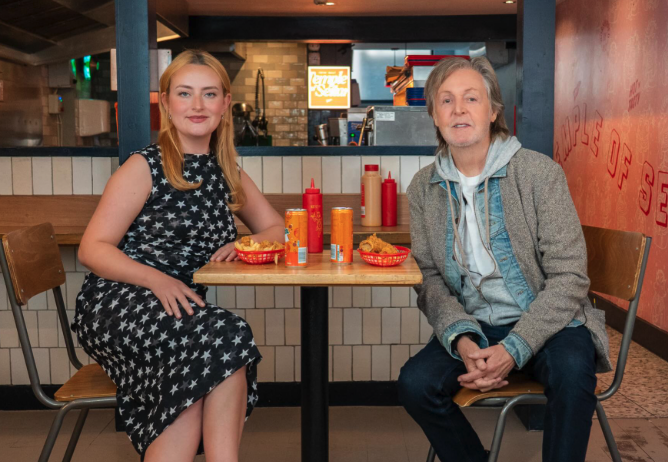
Britain’s Amelia Dimoldenberg did a brilliant interview with Paul McCartney last week as part of her web series, Chicken Shop Date. The highlight is a moment where she asks him if he advises her to take drugs, and he says, “we’ll talk.”
I’ve been reading a book called “Acid Dreams,” all about the role of LSD in reshaping contemporary culture, and there’s a good three pages on The Beatles, particularly Paul’s 1967 admission that he’d used the drug. So, it amused me to hear McCartney, almost 60 years later, demurring on the subject over vegan chicken nuggets. The poor guy’s just trying to promote his new album! But ironically, he still comes across well. There’s something cool about the fact that he’s up for the conversation that reflects positively.
McCartney is, obviously, extremely famous. The interview is super, though, because Dimoldenberg’s irreverent sense of humor matches that of the early Beatles, who were also totally irreverent. Today most people who interview Sir Paul treat him with the deference deserving a knight of the realm. But her style, which is by turn irreverent and disarmingly, flirty, just throws you off. It’s intensely watchable because you’d think you knew McCartney already, and yet she manages to create novel interactions with him.
For example, she asks him: “Who’s your favorite Beatle?” He says John. Then she says, “you’re mine.” And despite all the irreverence, it’s a genuinely sweet moment. She also asks him: “Did you once set fire to a condom?” And it turns out, yes, he did. WTF!
Later she says, “you’re quite good at writing songs,” and “you’ve done a couple of good ones.” This is after he’s rattled off his story about writing Yesterday.
I can’t imagine being capable of seeming so relaxed with the world’s most famous living person. Dimoldernberg’s ascent from a teenage youth club columnist to an Oscars red-carpet correspondent proves that audiences are hungry for authenticity, even if it is packaged a little differently. With 600 million people listening to podcasts worldwide, traditional media interviewing techniques, particularly of celebrities, feel like they’re on the way out.
Another great example of what I mean is Alison Hammond’s interview with Harrison Ford and Ryan Gosling about their reboot of the Bladerunner franchise. She makes a joke out of never having seen the original film and Ford finds the whole thing genuinely hilarious. I’m told he now “asks for” Alison to interview him whenever he visits the UK.
While Dimoldernberg often plays the fool onscreen, a character she describes to The New Yorker as “equal parts desperate and uninterested”, her approach is, in fact, rooted in obsessive preparation. Then drawing on her journalism training, she subjects A-listers to an onslaught of absurd, left-field questions. As she explained to Wired, her goal is to bridge the gap between traditional prestige media and online virality: “I feel like I am in the business of making entertainment. I think that’s a distinction from journalism in a way,” she said.
Behind her chaotic aesthetic lies a strategic mind; She spends months researching her guests for major events like the Academy Awards. Her onscreen bumbling is also calculated. “People think I’m being awkward but actually I’ve just forgotten where I’m at, so I’ll ask: ‘What’s your favourite colour?’ and they’re like: ‘You’re so funny!'” she told The Guardian. Yet, as she told Wired, her deadpan delivery started as a high school shield: “I think it was just a self-defense mechanism that just ended up being funny.”
A crucial element of Dimoldenberg’s $3 million media empire is her unyielding creative and financial control. Despite early, lowball offers from legacy media companies to buy the rights to Chicken Shop Date for as little as £500, she adamantly retained her intellectual property. Speaking to British Vogue, she admits she’s very driven: “I never, ever had an issue with being confident,” she said, adding, “Maybe I’ve always been delusional, but I’ve always thought I could achieve a lot with it.”
Bravo. This confidence extends into the editing suite, where she ruthlessly chops hours of footage into bite-sized, sub-ten-minute viral gold. She views herself as the ultimate protector of her guests’ images, noting to Wired, “I’m always trying to edit the person to be more charming than they actually are.”
I think her genius lies in using social friction to extract genuine sincerity. Traditional celebrity interviews are heavily polished, but Dimoldenberg actively seeks the uncomfortable silences and missed connections of a real first date. As she told The Guardian, “Awkwardness is part of life but it’s edited out of what we consume.” By challenging celebrities to navigate her unpredictable interviews, she effectively strips away their PR-trained armor. We should all be very happy to take notes.
Matt Davis is strategic communications consultant.