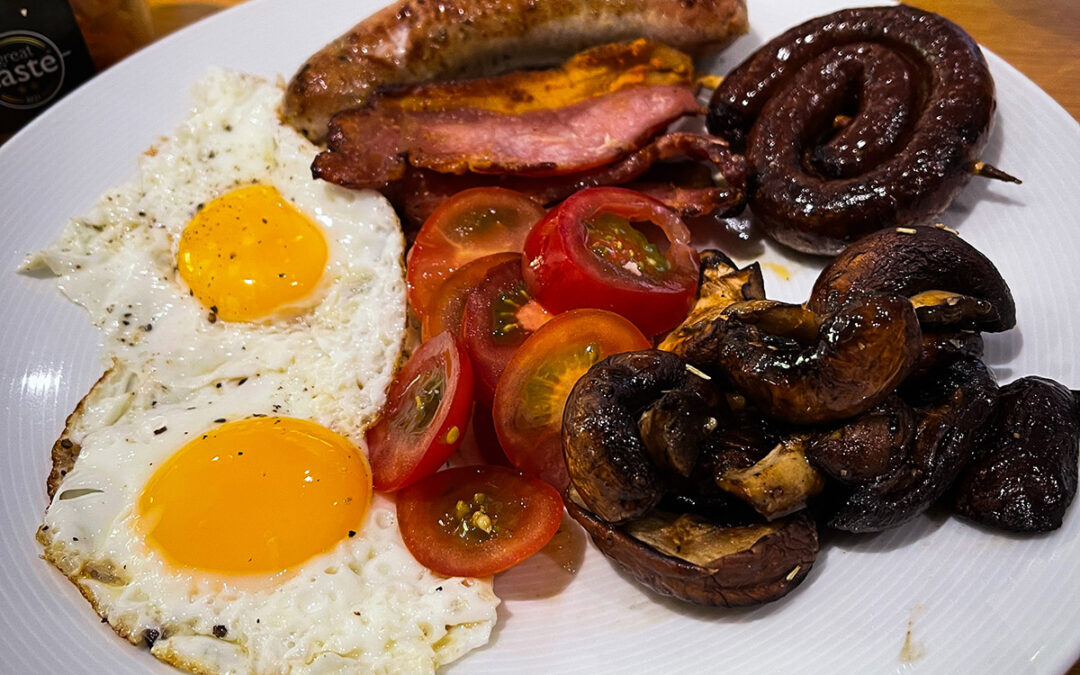
A fried English breakfast, courtesy of George Ames.
Born and raised in Southeast London, I moved to the U.S. at 26 and have now spent nearly half my life as an American citizen. Despite this, the ongoing World Cup often prompts questions about my loyalties. As a fair-weather fan, I find myself supporting England, currently the third-chance favorites, while observing that the U.S., despite a strong start, faces much slimmer prospects. Sorry, boys.
Yet, rooting for England is complicated by a deep-seated alienation from my homeland. I love the fried food, of course. But I have long struggled with a conflicted relationship with Great Britain, a feeling rooted first in the 2011 riots thatthreatened to burn down my hometown, and later intensified byBrexit. The 2016 vote felt like a suicidal turn for the country, fueled by an ugly election cycle that stoked nationalist and racist sentiments. Seeing my friends back home grow increasingly jaded in its wake has been difficult. The Atlantic ran a piece on the country’s self-sabotage this past week, titled“How Britain became as poor as Mississippi.”
Today, Britain appears to be tearing itself apart over immigration, with recent flare-ups of anti-migrant violence highlighting deep societal fractures. In one instance, a stabbing involving a Sikh man and a white student sparked a volatile debate over whether police reform has swung too far. In Northern Ireland, masked men have attempted to burn migrants out of their homes following another violent incident in Belfast.
Self-interested figures like Elon Musk and Nigel Farage have further inflamed these tensions. Farage, a leading architect of Brexit, has a history of stoking resentment; despite his denials,former classmates recall him voicing fascist sentimentsduring his school days. To me, he represents a dangerous path for Britain, yet he remains a viable contender for Prime Minister, illustrating how far the political center has shifted.
It is difficult to watch the British public succumb to such divisive rhetoric, especially when external forces are actively encouraging the chaos. Reports recently emerged that Russiatargeted the British Prime Minister’s residence, part of a broader pattern of interference that includedpushing for Brexit. The head of Britain’s security services has warned that we are now“operating in a space between peace and war”with Russia, which is utilizing “grey zone” tactics that threaten NATO stability.
I wish my home country could find the unity to resist this hostility. It seems the nation that produced The Beatles is now too self-critical to conjure its best self. Of course, my move to America might look like an easy escape, trading English challenges for a supposedly rosier life across the Atlantic. But the United States is hardly immune to these horrors. Russian interference helped bring about the era of Donald Trump, aided by political complacency.
Still, I find a specific freedom here: No one in the U.S. has ever dismissed my professional contributions based on my South London accent. In England, the persistent class snobbery, where being reminded I was from Croydon was often used against me, was a constant weight. The actor Michael Cainespoke very well about the frustrations of class snobbery in our native country.
Ultimately, my struggle with Britain is not a final goodbye. I do have a complex, lingering hope for my country. No nation is immune to the forces of division; the shared challenge for both Britain and America is learning how to rebuild a sense of unity amidst the deafening noise. I think it’s most important to remember that the divisions serve hostile nations. If you really want to “make America great again,” of Britain, then it begins with fighting those divisions.
Rooting for your favorite national soccer team after a good fried breakfast is probably a good place for me to start.