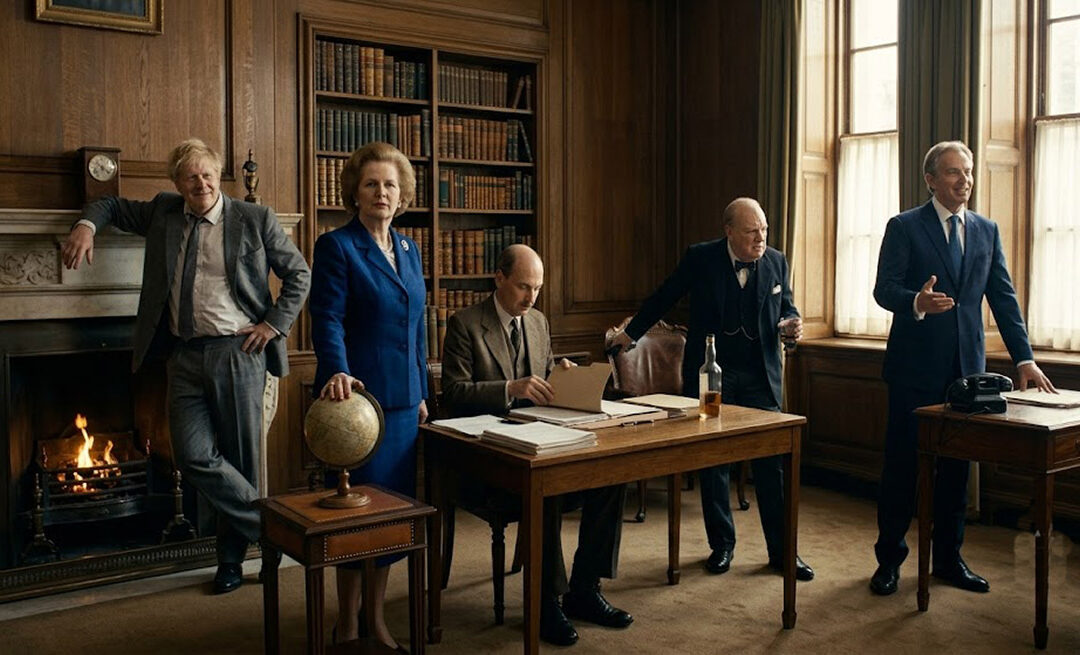
So, you want to be the next British Prime Minister. Congratulations. You have voluntarily chosen a career path with the job security of a medieval court jester and the public adoration of a traffic warden. To be a successful and impactful Prime Minister, two qualities that rarely share a sentence with “Number 10 Downing Street” these days, requires a bizarre, highly contradictory cocktail of personality disorders.
You need the ego of a rock star, the thick skin of a rhinoceros, the moral flexibility of a contortionist, and the absolute delusion that you, and you alone, can fix a country that has been proudly complaining about the weather since the Roman occupation.
Why are these qualities so hard to find in a single human being? Mostly because people with this exact psychological profile are either in prison, running a tech startup, or actively seeking therapy. Normal, well-adjusted people do not want to be blamed for train delays, inflation, and the dismal performance of the national football team all at once. The system naturally filters out the sane, leaving us with a very specific breed of political animal.
To understand the impossible alchemy required, let’s look at five historical examples of PMs who made an impact, and the uniquely terrifying traits that got them there.
1. The Churchill Prerequisite; A Good Crisis (and a Strong Liver)
Winston Churchill is the gold standard of British Prime Ministers, primarily because we conveniently ignore almost everything he did before 1940 and after 1945. His essential quality was being exactly the right kind of stubborn, theatrical madman for an apocalyptic crisis. To be impactful like Churchill, you don’t need good peacetime policies; you just need a catastrophic global conflict to distract from your domestic blunders. Why it’s rare: Thankfully, existential threats to the nation aren’t a daily occurrence. You can’t schedule a Blitz. Without a world war to harness his belligerence, Churchill was often a massive political liability. Modern PMs are left trying to manufacture their own crises, which doesn’t work. Although what about Russian interference in British affairs? Surely that could count, in a pinch? 2. The Attlee Anomaly; Aggressive Boringness
If you want to build something rather than just make good speeches and, you know, rely on the Americans and Russians to help you beat Adolf Hitler, you need the Clement Attlee approach. Attlee possessed the rarest of political traits: An utter lack of ego, paired with terrifying administrative competence. He gave Britain the NHS and the modern welfare state while possessing the stage presence of a mildly depressed bank manager. Why it’s rare: This quality is extinct today because modern politics is a 24/7 televised popularity contest. A modern Attlee wouldn’t make it past a local council selection meeting because he’d refuse to do a TikTok dance or pretend to enjoy pulling pints in a local pub for the cameras. I thought Keir Starmer was like Clement Attlee. Turns out his aggressive lack of charisma also masked an equal lack of management competence.
3. The Thatcher Syndrome: Absolute, Terrifying Certainty
To be truly impactful, you must be entirely convinced of your own righteousness, even when half the country is literally rioting in the streets. Margaret Thatcher possessed an ironclad, borderline terrifying certainty. She didn’t pivot, she didn’t care about focus groups, and she certainly didn’t care if you liked her. She changed the economic fabric of the country forever. She was nuts. Why it’s rare: In a normal human being, absolute, unwavering certainty is usually a sign of clinical delusion. In a politician, it requires a willingness to be historically despised by millions, a price that today’s focus-group-addicted, poll-chasing politicians are too fragile to pay. History has not been kind to Thatcher either.
4. The Blair Illusion: Weapons-Grade Charm
Tony Blair taught us that to win landslide elections, you need the supernatural ability to agree with everyone in the room while committing to nothing. Blair’s superpower was his elastic ideology and weapons-grade charisma. He could sell ice to polar bears and centrist neoliberalism to traditional socialists. Why it’s rare: Charisma on this scale requires a sociopathic level of polish. Eventually, the charm wears off, and you do something profoundly unpopular (like, say, dragging the country into a disastrous foreign war based on lies about “weapons of mass destruction”). The modern media cycle is now so ruthless that it destroys polished facades in about three weeks, meaning the “Teflon Tony” trick is more difficult to pull off today. See our next example.
5. The Johnson Maneuver: Pure, Unadulterated Shamelessness
Finally, to survive the sheer absurdity of Westminster, you need the shamelessness of a Victorian carnival barker. Fast-forward to a recent historical footnote: Boris Johnson. The required quality here is a blatant disregard for the rules of political gravity. If you act like the rules don’t apply to you, sometimes, for a surprisingly long time, they don’t. Impactful? In terms of constitutional chaos and Brexit, undoubtedly. Good? I’m afraid I regard Boris Johnson’s impact on Britain as catastrophic, so, no. Why it’s rare: Most normal people experience an emotion called “shame.” When you lack it completely, you can bounce through scandals that would sink a lesser mortal. Still eventually reality, and your own exhausted backbenchers, catch up with you.
The Impossible Venn Diagram
So, there you have it. To be a successful, impactful PM, you need Churchill’s luck in timing, Attlee’s boring competence, Thatcher’s ruthless certainty, Blair’s slippery charm, and Johnson’s complete lack of shame.
Why are they so hard to come by? Because the Venn diagram of people who possess all these traits, want to live in a drafty Georgian townhouse with terrible plumbing, and are willing to have their personal lives dissected by the tabloids daily, is basically just an empty circle. Meanwhile best of luck to the Mayor of Manchester, Andy Burnham, who seems keen to step up to the gallows next. It will be a miracle if he lasts three years.
Matt Davis is a strategic communications consultant.