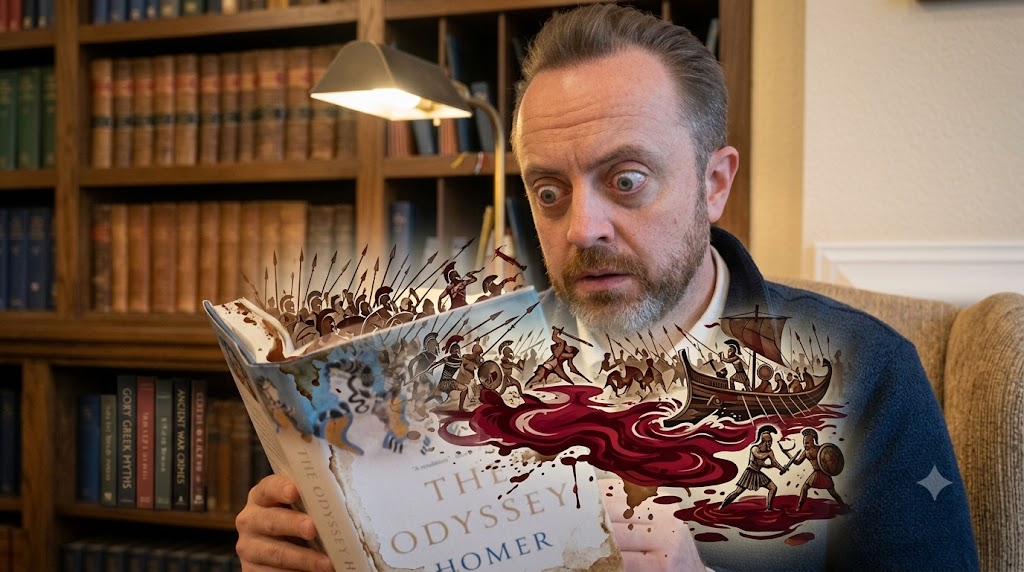
This is exactly what happened when I read The Odyssey on LSD. Thanks to Google Gemini for bringing the vision to AI-life for us. Also: Just kidding about the acid. No acid required. It’s already quite the, er…trip.
Hollywood is finally releasing The Odyssey on July 16, promising us too many hours of CGI monsters, sweeping Mediterranean vistas, and Matt Damon pretending he hasn’t showered in a decade. You could prepare for this cinematic event by reading the source material. But not many people have the time or energy to sit down and work their way through 400 pages of translated Ancient Greek poetry. Luckily for all of us, I do!
Here is what you need to know about Homer’s The Odyssey before you buy a ticket…
If you think it is just an ancient, chest-thumping adventure story about a flawless hero who slays monsters and returns to his weeping wife, think again. The text of the epic poem is far darker and more politically complicated than the sanitized versions many of us have heard secondhand. Underneath the mythology lies a brutal 3,000-year-old world defined by trauma, double standards, and ruthless domestic power struggles.
I recommend Emily Wilson’s 2017 translation. The first woman to translate the poem, she’s had to deal with her share of outraged Homer bros. The text is relatively easy to read and understand, and I appreciated her chapter summaries. It felt like she wanted me to read the poem myself so that I could figure out what I thought of it. I’m grateful for her hard and wonderful work. Seriously. It only took me a few days to get through, and I felt so smart afterwards. What an experience.
The Hero is a “Complicated,” Straying Husband
At the center is Odysseus, the warrior-king of Ithaca. After ten years fighting in Troy, he spends another ten navigating his way back home. Homer introduces Odysseus in the very first line of the epic with the complex Greek word polytropos. While older translations called him “prudent” or “wise,” a more accurate modern rendering is “complicated”. This word carries a deliberate double meaning: He is either “much turned” (a passive victim tossed around by gods and fate) or “of many turns” (a shifty schemer who turns every situation to his own advantage).
All I can say is that I certainly found his maneuvering familiar in parts!
It’s also important to note that Homer as we understand him probably didn’t exist. The poem was passed down through oral tradition and amended many times before it was written down. Like the Bible or the works of Shakespeare, the version we read today is attributed to “Homer,” but it’s actually the collective tradition of Ancient Greece. I found learning that — in Wilson’s comprehensive introduction — helped me to understand the complexities and contradictions in the story better.
While Penelope spends 20 years in tearful isolation fending off abusive suitors in Ithaca, Odysseus is serially unfaithful. He spends seven years in bed with the goddess Calypso, and shares a bed with another goddess, Circe. Homer pointedly makes clear that the goddesses are hotter than Odysseus’s wife. Awkward. At the same time Odysseus longs for Penelope and wants to get home to her. It brings new meaning to the idea of homely looks.
Odysseus also charms Nausicaa, a teenage princess, hiding his marriage because his survival depends on her. Defined as polymechanos, a “man of many devices,” “very resourceful,” and “full of schemes,” he is the guy who always has a quick fix even if it’s morally ambiguous. If I’m honest, however, the poem is about a straying husband clawing his way back to his property which partly includes his wife. He’s ripe for cancelation by contemporary standards. And yet he’s a richly drawn character. I think we are supposed to reflect on his shortcomings. I certainly did. I could imagine a way of telling the story to bring them out more, or to suppress them. I hope the film doesn’t sanitize Odysseus too much.
Penelope is Gritty, Stuck, and Deeply Unhappy
Many want Penelope to be an empowered feminist icon, but her actual situation is grim. While Odysseus has endless choices, identities, and places to go, Penelope can only wait for his return or marry an abusive suitor. Yet she is exceptionally sharp and gritty. For years, she holds off suitors by claiming she cannot remarry until she finishes weaving a shroud, which she secretly unpicks every night. When Odysseus returns in disguise, she needles him by pretending she moved their bed, constructed from a living olive tree, reminding him she has the power to wound him. I’m intrigued to see how Anne Hathaway interprets the character. The director, Christopher Nolan, is not very good at complicated women so I’m not too optimistic.
Her intelligence is periphron (cautious and circumspect), keeping her stuck. In one of the poem’s most difficult scenes, her face and skin melt away with tears like thawing mountain snow. Even when Odysseus returns, she remains unhappy. In Book 19, she dreams of an eagle slaughtering her beloved household geese, weeping in her sleep over the loss, For Penelope, her husband’s return represents grief and a loss of identity, rather than a happy ending. Welcome home, honey!
The Manosphere of Ancient Household Life
The climax of the Odyssey is celebrated as a heroic triumph, but it’s a gruesome bloodbath asserting his absolute male authority. After slaughtering the suitors who overrun his palace, Odysseus orders his son, Telemachus, to execute the household’s female slaves who slept with them. Telemachus, who in Book One famously tells his own mother to be silent, carries out the command with terrifying brutality. He brutally hangs twelve of these young, enslaved women in the palace courtyard. While standard study guides and translations euphemistically call them “disobedient maids” or abuse them in worse terms focused on their supposed promiscuity, the original Greek text uses no such derogatory language. These women were slaves (dmoai) with zero agency to refuse the sexual demands of the powerful suitors occupying the palace. They are executed like caught birds, gasping as their feet twitch in the air. Telemachus reminded me of an incel nutcase. I hope Tom Holland plays him appropriately. I’m nervous that much of this subtlety will be lost in the film.
True Female Power Belongs to the Gods
To find actual, unconstrained female power in the Odyssey, look to the heavens, not the mortal world. The gender-fluid goddess Athena protects Odysseus and engineers the entire plot, often transforming into a bird of prey. Goddesses like Calypso, Circe, and the monstrous Sirens, who are terrifying bird-monsters devouring men with songs of total knowledge, rather than sexualized mermaids, represent fantasies of power impossible for mortal women constrained by patriarchal structures.
The Odyssey is not a simple story of adventure, but a complex, raw exploration of gender dynamics, trauma, and the terrible human cost of establishing domestic order. It is a story that, three thousand years later, still has the power to make us deeply uncomfortable. I’m intrigued to see what the film makes of the story and would love to hear from you if you’ve also been inspired to read and reflect on the original. I just hope it doesn’t haunt your dreams too much, afterwards.
____
Matt Davis is a strategic communications consultant.