Are you nervous about getting caught using AI to write your most important materials? Drop me a line and I’ll draft them from scratch. That’s not cheating. It’s called hiring a brilliant ghostwriter. Far from risking your reputation, it makes you sound more powerful and important! You’re welcome.
You could also call it insurance against career-jeopardizing embarrassment. Speaking of which…
Harvard Professor Ricardo Hausmann has come-a-cropper for using AI to write. Hausmann, a former Venezuelan Government Minister, wrote a piece criticizing Trump’s tariffs. Or rather, he wrote a long screed about the tariffs, then used AI to condense the screed into column length. At least, that’s his story, and he’s sticking to it. Now his column in the Financial Times comes with this dagger of a disclaimer:
“It has come to our attention that AI was used to condense a longer draft of this column prior to submission to the FT and our own editorial involvement. The FT editorial code of conduct specifically prohibits the use of AI in the writing process. The writer is a professor at Harvard’s John F Kennedy School of Government and director of the Harvard Growth Lab.”
Ouch. It sounds like the FT is furious, furious, furious about the professor’s laziness. I can only imagine their exchanges before the editors added the disclaimer. I can only imagine how many lawyers had to get involved.
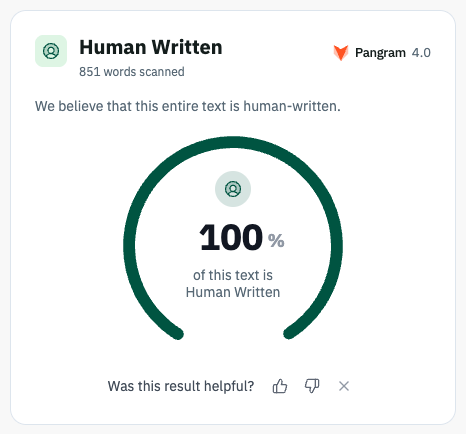
Then something similar happened again this week. Scott Bessent’s billionaire mentor wrote an op-ed for the Wall Street Journal. Or rather, he had ChatGPT write it. If you run the copy through Pangram, which detects AI, and with 99.9% accuracy, it’s 100% AI-written. People on Twitter ran it through Pangram and posted the results. “Amazing that there is no demerit to this any more,” wrote one observer.
I disagree. You do not want to get caught using AI to write your most important documents. Sure. Have it churn out your HR policies and white papers nobody’s going to read. Kidding. Your HR policies, though, sure. But if you put your name on something that gets detected for AI? You could be in big trouble. I don’t want that for you. I’m like the writing equivalent of the small-time crook who goes into bodegas out in Queens and says “This is a nice store. It would be a shame if something happened to it.”
Except your reputation is the bodega out in Queens, and I’m not in the mob. I promise.
My brother is a college professor, and we’ve been talking about AI use by his students. Plenty of them are using it, and it makes them more stupid, he says. The biggest incentive to avoid AI in your writing, it turns out, is to maintain your sharpness for the future. When you use it, you’re signing over your intellectual inheritance. Bad idea. Especially if you’re young.
Can my brother prevent his students from cheating? Not much. But he can ensure that they hand-write their end of year exams under invigilation. And he can weight them heavier when he’s assigning his students’ grades.
Employers, too, and even editors of publications, are hamstrung. If a member of staff says they didn’t use AI to create materials, you must believe them. You might even have evidence to the contrary, but it’s difficult to tell your people you don’t trust them. Would you promote the person, though? Would you hire them to freelance for you again? No. So there’s a cost to using AI and assuming you are getting away with it. You’re eroding trust.
It’s no coincidence that tech leaders forbid their children from using most technology. It’s no surprise either that major companies who recruit graduates are encountering stupidity. Get AI-natives in a room and ask them to think through a problem and they reach for the robot’s help. I still find it mind-blowing that we landed on the moon using a computer with 4 kilobytes of memory. It’s not your chip power that matters most. It’s the people steering the ship. When it comes to the direction of our country lately, we need all the guidance we can get. But not, I emphasize, from our computers.
From a writing perspective, I’m very grateful I came of age in an era when I needed to learn to do it. It’s not only so I can lord it over people who are less qualified. I like writing because words have weight and meaning, and they matter to me. The things they describe are also important. Writing is how we exist in the world and I, for one, am reluctant to live less fully by delegating that awesome power.
The FT, of all places, called out Stanley Druckenmiller’s column in the Wall Street Journal for its AI use. Druckenmiller told Jeff Stein at NotUs.org that “of course” he’d written the piece using AI. In fact, “I write everything using AI now,” he told the publication this morning. What’s next? The President using AI to write his speeches? It’s the definition of checked out. Then again, perhaps in his case it would be appropriate. More time for napping.
Matt Davis is a strategic communications consultant.