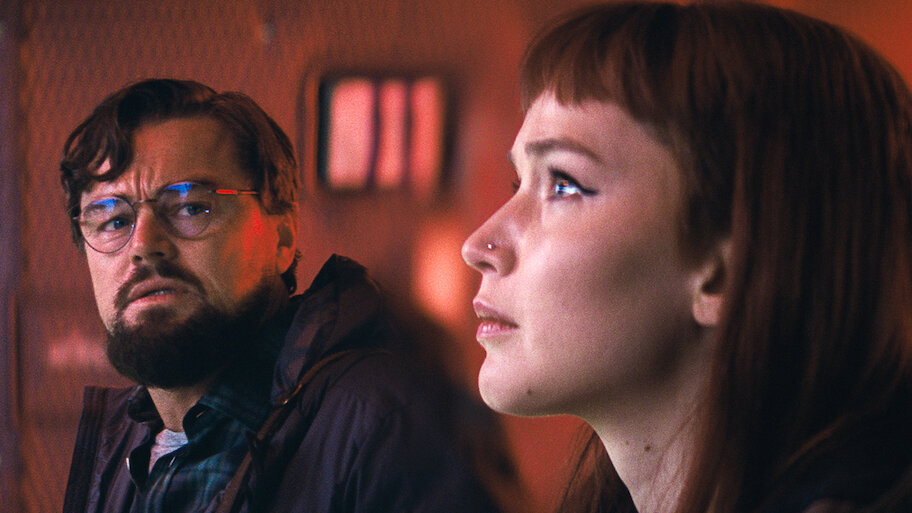
Jennifer Lawrence and Leonardo DiCaprio in Don’t Look Up, 2019.
It’s Climate Week in New York. Midtown is wall-to-wall tote bags, panels, and important people saying “let’s circle back.” Full disclosure: I wasn’t there. But a friend and occasional colleague was, and he sent me a stat from a panel that rearranged my brain a little. Only 1% of climate funding goes to culture work. For the thing that actually changes how human beings feel about anything. The funding context is worth spelling out: The Climate Policy Initiative puts global climate finance flows at $1.3 trillion a year. That’s about 1% of global GDP. But CPI estimates the global need for such funding at around $6.7 to $10 trillion a year. That is, if we’re serious about restricting climate change to 1.5°C by 2050. 🤷
So, yeah. The money to save the planet is 1% of the global economy. And culture work, the storytelling engine that could make anyone care, gets 1% of that. One percent of one percent. As a comms person, as a writer, as a creative brain, as a human being, this offends me a little. As somebody who would like his grandchildren to be able to inhabit Planet Earth, it gets me hot under the collar, also. It’s like shooting a movie and spending 99% of your budget on the catering. The maddening part is that culture work…works. You can measure its impact which is, supposedly, the thing funders care most about.
- After Blue Planet II aired its plastics episode, 88% of viewers changed their behavior. Waitrose saw an 800% spike in customer questions about plastics. Both the BBC and the Houses of Parliament banned single-use plastics. One hour of television did what decades of reports couldn’t.
- The nonprofit Rare studied the impact of the Netflix movie Don’t Look Up across 10 countries. It’s a movie starring Jennifer Lawrence and Leonardo DiCaprio. Two astronomers go on a media tour to warn humanity about an approaching comet that will destroy us all. The response? A collective “meh.” Rare found watching the film shifted real attitudes. Perceived threat of climate change went up 10.5 points. There was also a 10.7% drop in willingness to vote for candidates who oppose climate action. A satire starring Jonah Hill moved votes more than most advocacy campaigns!
- Artist Olafur Eliasson hauled 80 tonnes of Greenland’s ice to the Place du Panthéon during COP21. Then, he let it melt in front of Paris. People hugged it. Rebecca Solnit called the photos “tears of a Greenland glacier.”
- In 2019, around a hundred Icelanders hiked two hours up a volcano. They held a funeral for Okjökull, the first glacier lost to climate change. Then they installed a plaque titled “a letter to the future.” It ends: “This monument is to acknowledge that we know what is happening and what needs to be done. Only you know if we did it.”
- This all brings me, too, and with some controversy, to my friend’s recent AI-written novel. I know. It’s a sad concept and also, I know, AI has a role in a lot of bad stuff. Including climate change. Not to mention cheapening writing as a whole. But. He wrote an AI thriller about diving in a loch. It was a proper page-turner, twists and all. Somehow he turned it into the most urgent argument I’ve read for preserving the loch floor. No foundation issued an RFP for “innovative benthic narrative advocacy.” He told a cracking story, and now I’m more concerned. I do still feel a bit icky about reading all that robot writing but if propagandists are using AI for evil, then there must be opportunities to use it for good, too.
Since funders need culture work ideas, here are some, free of charge: How about a film fund for climate stories that aren’t documentaries? Give me a climate heist movie? Better yet, cast Jennifer Lawrence in it! What about months-long influencer partnerships? I want to see the Beckhams bend their carbon footprint! A theatrical prize with real money behind it? An annual prize for the best climate novel? Video games? Comedy writers’ rooms? Murals? A soap opera with a fossil fuel lobbyist as the villain?
Thanks for piquing my interest, Climate Week. The possibilities are real.
____________________________
Matt Davis is a strategic communications consultant, novelist, and fan of “human-created content.”