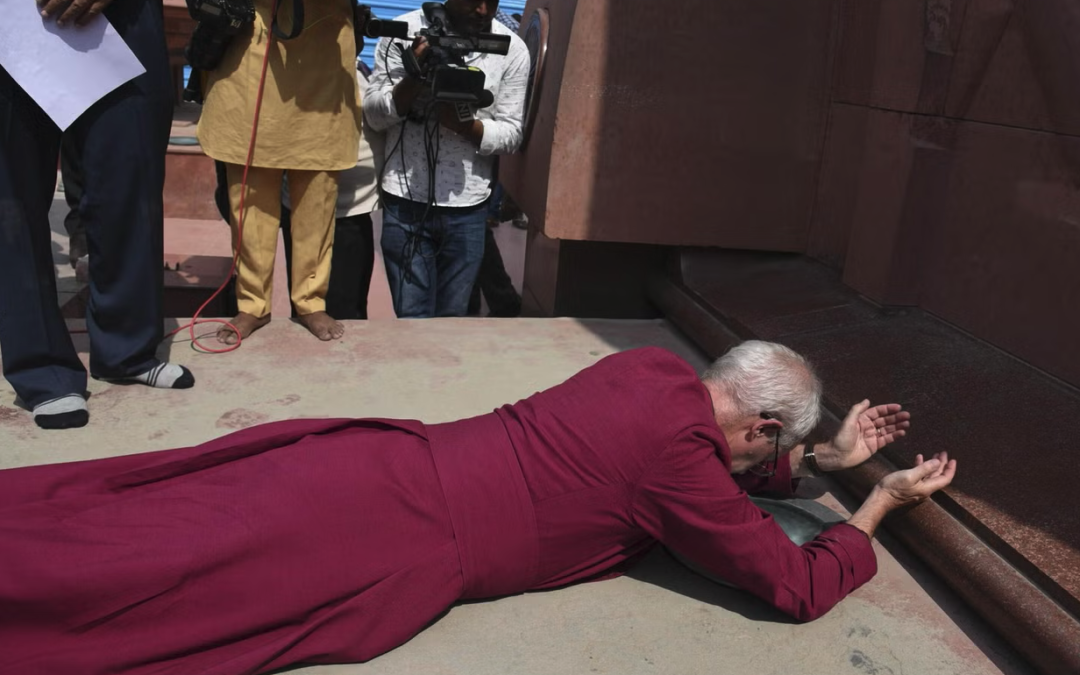
The former Archbishop of Canterbury, Justin Welby, prostrates as he pays respect at the Jallianwala Bagh memorial in India, 2019.
There’s a special kind of silence that falls after a bad apology.
The Tennessee Titans, an NFL team, started the season 0-5, and their president and CEO, Burke Nihill, apologized to season-ticket holders, saying the owner was “feeling a lot of grief” about it. Then he described 33 losses in 39 games as “stability.” A large chunk of the fanbase decided the apology email wasn’t even written by Nihill, they suspected it was AI-generated. Now he’s in a tight spot.
For your apology to be sincere, you can’t have a bot write it. Really. This is complicated stuff! A.A. Gill, the Scottish critic who spent most of his life in England explaining the English to themselves, wrote in The Angry Island that the English have invented “deflective mechanisms” to diffuse their anger, and that the simplest of them is the apology. Then he produced a list of the many things the word “sorry” can mean, to an Englishman:
“There is: sorry, I apologize; sorry, I don’t apologize; sorry, you can take this as an apology, but we both know it isn’t one; sorry, will you shut up; sorry, empathy; sorry for your loss; sorry, I can’t hear you; sorry, incredulity; sorry, I don’t understand you; sorry, you don’t understand me; sorry, excuse me; sorry, will you hurry up; sorry, I don’t believe you; sorry, I’m interrupting; sorry, this won’t do; sorry, I’ve reached the end of my patience; sorry, sad and pathetic — as in, sorry excuse or sorry little man… Sorry is a prophylactic word. It protects the user and the recipient from the potentially explosive consequences of the truth.”
Fluency in apology is knowing which blade you’ve opened on the Swiss Army Knife of Sorry. Corporate apologies have the same problem, except every blade is blunt and at least one of them is pointing at the user. The lesson? Be very careful indeed how you apologize.
Case in point: The CEO of Petronas, Tengku Taufik, recently got himself filmed joining a champagne spray at a podium celebration — always going to be a problem for a Malay Muslim leader of a government-linked company. His apology said his participation “may have been misplaced” and apologized for “any unintended offence caused.” Practitioners pulled it apart: “may have been” suggests uncertainty, not acknowledgement; “any unintended offence” apologizes for feelings, not for the act itself. It’s corporate speak for “sorry you feel that way.”
What about the crying CEO? In August 2022, Braden Wallake, founder of the B2B marketing agency HyperSocial, laid off some of his staff and posted a selfie of himself crying about it on LinkedIn. “This will be the most vulnerable thing I’ll ever share,” he wrote. The internet was merciless, and more so when it emerged that only two people had been let go. The tears were probably real. They were also all about him. Then again, HubSpot’s founder recently thanked the roughly 660 people the company had just laid off in a breezy 28-word LinkedIn post that readers called cold and impersonal. The word “sorry” could have been judiciously used as, say, the 29th word, there.
There are counterexamples of how to apologize well. In September 2019, the then Archbishop of Canterbury, Justin Welby, went to Amritsar in India, to the memorial for the 1919 Jallianwala Bagh massacre, where British troops shot dead hundreds of unarmed Indians — and lay flat on the ground before it. He said he had no status to apologize on behalf of the UK, but that he was “personally very sorry for this terrible atrocity.” A historian noted the image’s extra sting: It echoed the 1919 “crawling order” that forced Indian men to crawl at bayonet point.
Welby did the same kind of thing with slavery. In Jamaica in July 2024, at the Diocese of Jamaica’s 200th anniversary service, he told the congregation: “We are deeply deeply deeply sorry. We sinned against your ancestors.” Behind that stood a £100 million reparative fund. It might have taken the Church of England a few generations to get around to it, but an apology with some reparative money attached strikes a very different note.
______
Matt Davis is a strategic communications consultant.