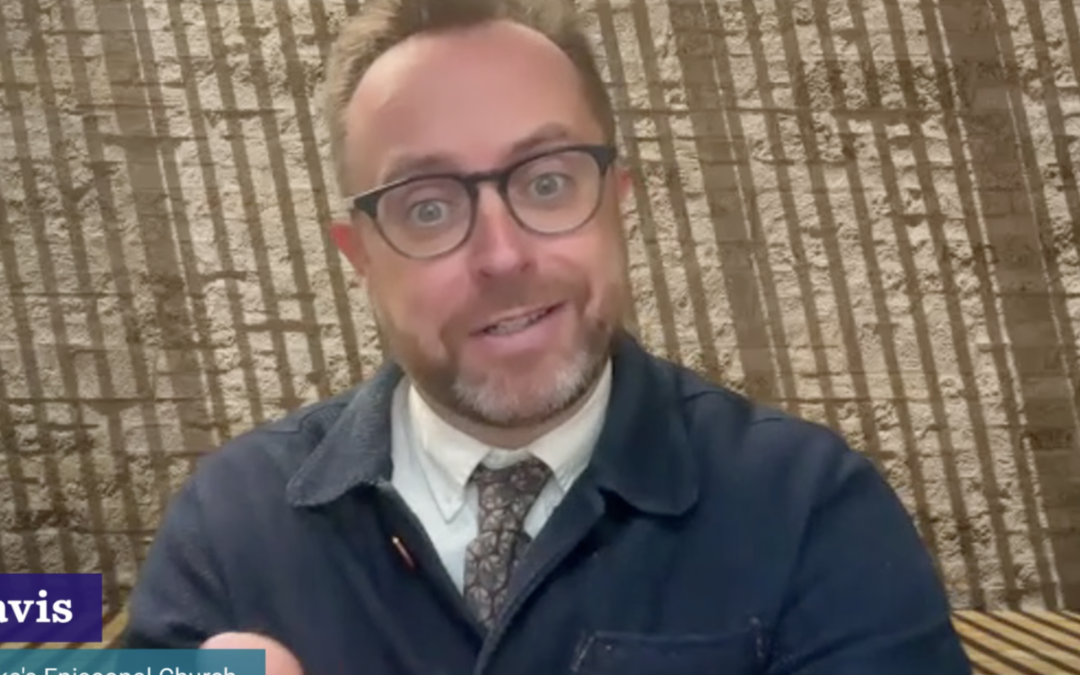
A few weeks ago, I sat down with my occasional colleague Kate Purcell for a chat on her podcast. She’s a designer, creative strategist, and host of the podcast Messy Beautiful Impact. We talked about impact in a church setting. The show is about the mess of making social change. The episode, “The Small Stuff Is the Big Stuff,” is live now and you can listen to it here.
Kate and I met at a nonprofit communications conference during COVID. About a year ago I pivoted from the big national campaigns. Now I run church communications for a single congregation in Norfolk, Virginia. Kate wanted to know why, and what “impact” even means once you choose to stop working at a larger scale.
The honest answer starts with values on a wall. My first job was at Barclays Bank. “Honesty” and “truth” adorned their lobby while the bank profited from apartheid. I left, did 10 years in journalism, then went into nonprofit communications. I found the same pattern at the other end of the money. Big foundations write their values on the wall. They hold seminars about what equity means. Sometimes there are even a few Black people present.
The question Kate kept coming back to was the real one. Can I, with my Manhattan values, live in a community where I’m engaging with Trump voters? My answer is that for me it isn’t about following a series of strategies. It’s about faith. Which I hate saying, because I get sheepish talking about being a Christian.
My dad’s an atheist, my mum was sort of Methodist, and we were not a Church of England family. A Church of England family in England is like Rowan Atkinson in Four Weddings and a Funeral, sort of snooty posh. We weren’t that. We were a sort of lower middle class, south-east London family. I flirted with atheism over the years, with meditation and yoga, and I arrived at church the long way round. What finally got me there was a rector who told me I didn’t need answers to any of it. “You don’t actually need answers to this stuff. Come to church and sit there on a Sunday and let it work on you a bit.” And it worked. Six years of sitting there, and somewhere in there I realized I couldn’t make the hard things add up on my own. I can’t reconcile unforgivable behavior with my ability to forgive somebody. I can’t do it. I can’t talk to a Confederate-supporting Trump voter without some help. But that, it turns out, is what the faith is for. America is better united than divided. I know it. Even if striving for such unity is a real challenge.
Which brings me to the story that gives the episode its title. I was filming a piece about our Thursday lunch ministry and talking with one of the volunteers. She’d drifted away when her kids were teenagers and come back when the nest emptied and she felt a bit lost. There’d been a sermon around then in which the rector called out the people who always leave early. He said “come and have a chat with me, let’s get you more involved.” She did. She started cooking lunch on Thursdays for homeless people. Some with justice-system involvement, some with behavioral health challenges. Shy at first, then she started actually getting to know these folks. She has real relationships with them down in the basement. She said to me, right there, she understood what she was doing. She is here to be doing this with these people. She described moments that reminded me of the parables. It’s the same feeling I’ve had interviewing a homeless person about their experience. Or when I’ve spoken with farm workers in California. You know, in those moments: This is what I’m meant to be here doing.
And that, I said to Kate, is the big stuff. You can find that interaction with a parishioner on one afternoon. It’s as valuable in that setting as it is in any foundation. Even where they’re talking about moving billions of dollars.
And then there was the class thing.
Somewhere in the conversation I described my family as lower middle class, as I have up there above. I said it without thinking about it, the way you say something you’ve said about yourself for years. And then I heard from friends in England, who had listened to the episode, and who had — hee hee hee — “raised an eyebrow.”
What followed was a days-long argument. Not about the podcast. Not about impact, or faith, or any of the fascinating subjects Kate and I had actually discussed. About my class. Their position, argued at considerable length, was that I am middle middle class. At least. It’s arguable I’m even “upper middle class.” Saying I am “lower middle class” is dishonest, they contend. It’s either false modesty or a failure to understand my own life.
I love these people. But we spent days on this. Days. The episode is thirty-four minutes long. It contains, among other things, my thoughts on doubt and forgiveness. We talk about disability and religion. But the thing my oldest friends wanted to litigate was whether I had classified myself right. In a system that most of them would also insist doesn’t exist anymore, if pressed.
Which is exactly why I love living in the United States, now. Here, nobody cares. People care about a hundred other things. But the specific parlor game of placing someone on a ladder with six rungs is not a national sport. I don’t know which of us is right about the class question, and I have decided I don’t care. The argument itself was the point.
There’s a reason I’m telling you this, beyond the pleasure of reporting that my friends think I’m posher than I am. I’m more interested in podcasting as a medium for doing thought leadership. Not the polished position paper. Not the strategy document with the rough edges sanded off. A conversation, with another person, where you must think out loud and can’t hide behind the editing.
That’s what Kate’s show gave me: 34 minutes of having to answer questions, in real time, without a draft. No talking points, no second take. The conversation was messier and more honest than anything I would have written. It included bits I hadn’t planned to say, like the class thing. Which, of course, is what turned out to be the bit everyone wanted to talk about afterward.
In the New Year I’ll be co-hosting a podcast of my own. It’s an ethical dilemma show with my boss, the priest at church. We’re going to call it “What Then Must We Do?”
And the more I do this, the more convinced I am that the form suits the work. Thought leadership, if it’s going to be worth anything, should sound like we are thinking. It shouldn’t sound like a brand. It should have the hesitations and the wrong turns in it. It should bring up interesting detours and disagreements. It should prompt further thought and discussion.
So, I’m doing more of it. More conversations, more microphones, more thinking out loud. And if you’re one of the friends from England reading this: Middle-Middle, then. Even: Upper. Whatever floats your boat. I’ll see you on the next podcast to discuss it!
Matt Davis is a strategic communications consultant.